Time in Stone
How Jantar Mantar measured the sky long before the wristwatch
Editor’s Pick
Long before time lived on the wrist, it lived in the sky.
Before gears, springs, batteries, or dials, time was observed, not owned. It was read through shadows, stars, and the steady movement of the sun. One of the most precise expressions of this ancient relationship between humanity and time still stands today at Jantar Mantar.
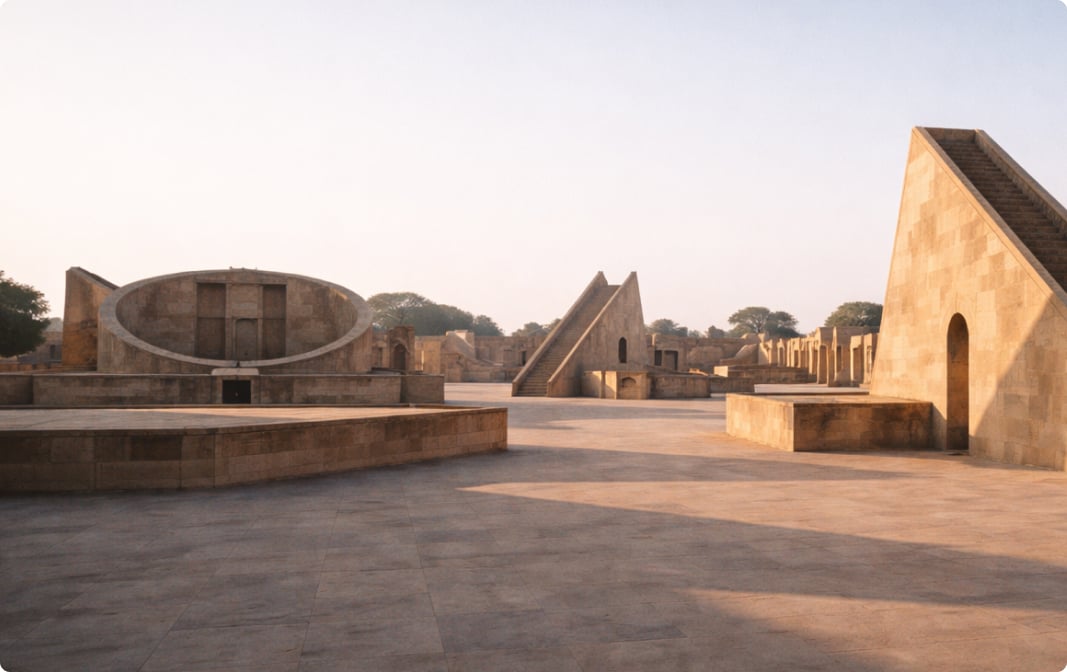
At first glance, Jantar Mantar feels monumental, an abstract landscape of stone forms and sweeping curves. But it isn’t a monument in the traditional sense. It is a working instrument, a place built not to commemorate time, but to measure it.
For most of human history, time was collective and contextual. It governed agriculture, rituals, navigation, and prayer. Accuracy mattered, not in seconds for convenience, but in precision for survival and order.
The challenge was clear. How do you measure something invisible?
The answer lay in astronomy. By tracking the movement of celestial bodies with fixed reference points on earth, early scientists learned to map time with remarkable consistency. Sundials, star charts, and observational tools became humanity’s first timekeepers.
Jantar Mantar represents the pinnacle of this thinking.
Commissioned in the early 18th century by Sawai Jai Singh II, Jantar Mantar was designed as a precise astronomical observatory. Jai Singh II was not only a ruler, but a mathematician and astronomer deeply invested in improving the accuracy of timekeeping and celestial measurement.
Each structure within the complex serves a specific purpose, tracking solar time, measuring declination, and observing planetary positions. Nothing is decorative. Everything is calibrated.
In an era without digital correction or mechanical regulation, precision was achieved through scale.
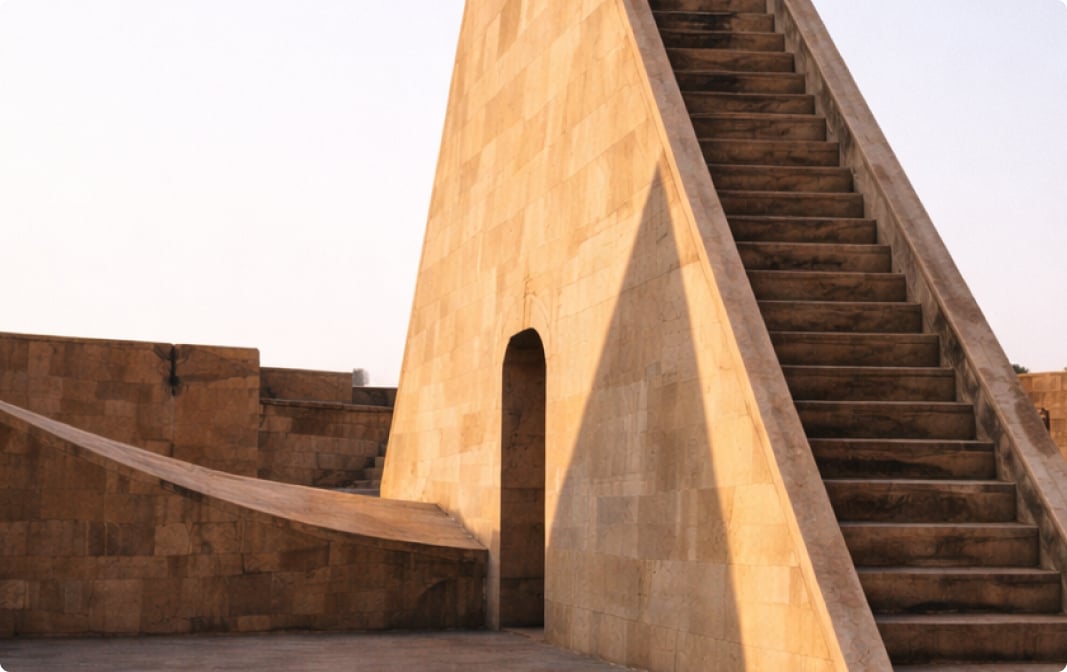
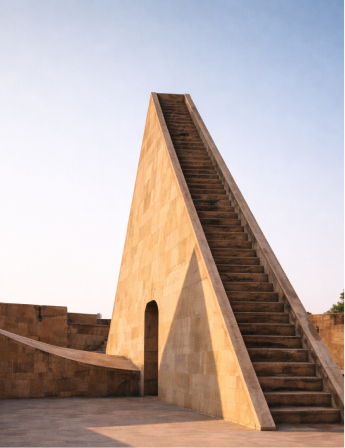
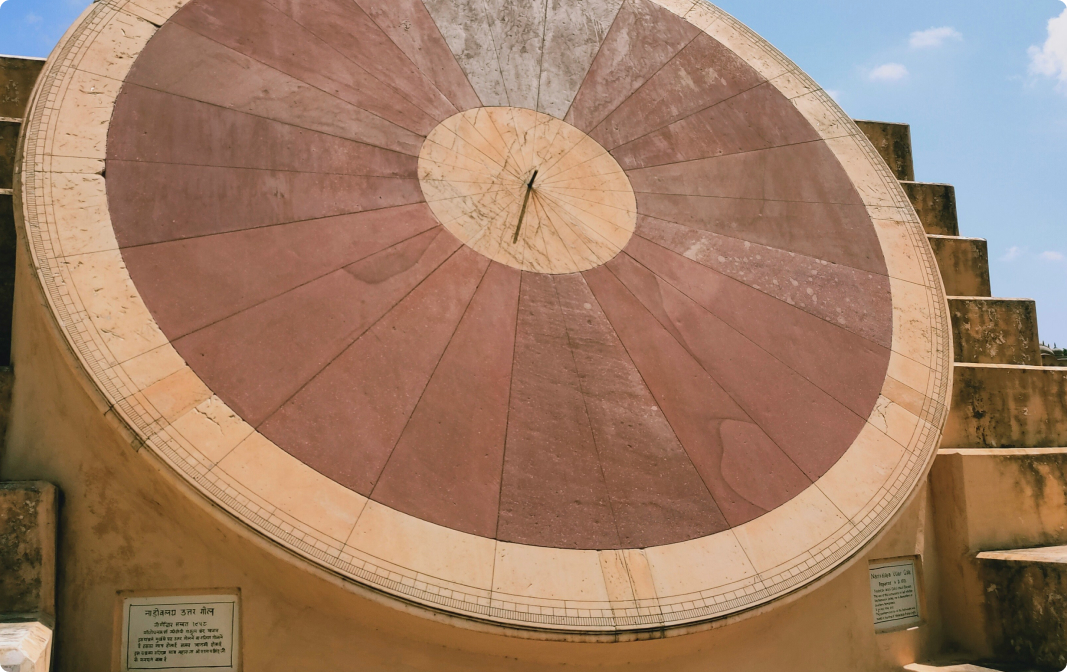
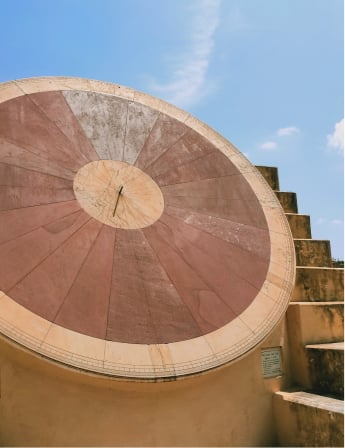
At the heart of Jantar Mantar stands the Samrat Yantra, the world’s largest sundial. Rising over 20 metres high, its triangular gnomon casts a shadow that moves predictably with the sun.
Here’s the extraordinary part. The Samrat Yantra can measure time to an accuracy of about two seconds.
This was achieved not by miniaturisation, but by enlargement. The larger the instrument, the smaller the margin of error. Where modern horology refines accuracy by shrinking tolerances, Jantar Mantar refined it by expanding form.
Different approach. Same goal.
Unlike a wristwatch, Jantar Mantar didn’t offer instant time. It required observation, interpretation, and correction. Clouds could obscure readings. Seasonal shifts demanded recalibration. Human attention was part of the system.
Time wasn’t passive. It was participatory.
In this way, Jantar Mantar reminds us that precision has always been a dialogue between design and discipline. Whether carved in stone or assembled in steel, accurate timekeeping has never been accidental.
Modern watches compress what Jantar Mantar spreads across stone courtyards. The principles remain unchanged, alignment, consistency, repeatability, and trust.
What shifted was scale and portability, not philosophy.
Jantar Mantar stands as proof that horology didn’t begin with the wristwatch. It began with the human need to understand time as something measurable, dependable, and shared.
In a world where time is increasingly digital and invisible, Jantar Mantar offers a rare reminder. Time was once physical. It cast shadows. It demanded patience. It was shaped by design choices made in full view of the sky.
Stone or steel, shadow or seconds.
Time has always reflected how carefully we choose to measure it.
Removed from the wishlist
Product moved to cart
Add minimum 2 products to compare
You may compare up to 4 items at a time
Added to wishlist