08th Oct, 2026
.
Swati Sharma

Best Wall Clocks for Living Rooms in India 2026 - Style, Size and Placement Guide

Not sure which wall, what size or which direction? Find the right wall clock for your living room, with practical placement and Vastu guidance. 

Best Wall Clocks for Living Room 2026: Style & Size Guide

Not sure which wall, what size or which direction? Find the right wall clock for your living room, with practical placement and Vastu guidance. 

There is usually one wall in a living room that nobody quite knows what to do with. The sofa has claimed its spot, the television owns another, and whatever's left goes to a console, a few photographs, a stray piece of art. Then there's the wall in between, the one that just sits there, waiting for a decision nobody's made yet.

A wall clock is often the answer and a better one than people expect. It asks for almost no space, gives the eye somewhere to land, and does double duty as both function and décor. 

Quick Answer

For a larger wall, Titan Classic Wooden Wall Clock suits warm, traditional interiors, while Titan Metallic Wall Clock works well with contemporary rooms featuring rose-gold or brass accents. Titan Contemporary Colours Clock adds a lighter green accent to medium-sized walls, and Titan Classic Pendulum makes a statement with its moving pendulum, Westminster chime, and automatic night shut-off. And the Titan Premium Digital brings a clear, information-led display to your wall. 


Types of Wall Clocks Best Suited for Living Rooms

Look around your living room before you look at clocks. A home with carved wooden furniture, family photographs, and art collected over the years calls for a different clock than a sleek city apartment with glass surfaces, marble, and a Scandinavian look.

Contemporary wall clocks

Works best when - The room has clean lines, simpler furniture, modern storage or a restrained colour palette.

Why it works - A contemporary clock can reinforce the room’s uncluttered look without adding too much visual weight. It is especially useful when the living room already has a television, shelving or artwork that needs to remain the focus.

Think about colour, scale and contrast. A clock that is too small may disappear on a large wall, while a bold design may compete with artwork or decorative objects.

Wooden wall clocks

Works best when - The room includes timber furniture, warm neutrals, woven textures, leather, linen or more traditional decor.

Why it works - Wood introduces warmth and makes the clock feel connected to the rest of the room. It can soften a space with pale walls and modern furniture, or sit naturally among existing wooden pieces.

See whether the clock uses actual wood or a wood-effect finish, and whether its tone works with the furniture nearby. The wood does not need to match exactly, but very different undertones can make the combination look accidental.

Pendulum and chime wall clocks

Works best when - You want the clock to become a feature rather than remain a background accessory.

Why it works - A pendulum adds movement, while a chime gives the clock an audible presence. This can bring character to a traditional living room or a large feature wall that feels too empty with a standard dial.

Sound, vertical clearance, and maintenance are important factors here. Make sure the pendulum has enough room to move freely and decide whether you will enjoy hearing the chime throughout the day. If the clock has an automatic night shut-off, check the hours before buying.

Metallic wall clocks

Works best when - The room includes marble, glass, metallic lighting, mirrored surfaces or contemporary furniture.

Why it works - A metallic frame can add polish without requiring a major change to the room. Rose gold, brass, black metal and silver can each create a different effect, from warm and decorative to sharp and architectural.

The metal tone and reflections can make or break the aesthetic based on placement. The finish does not have to match every fitting, but it should relate to nearby details such as lamp bases, cabinet handles or mirror frames. Glass can also reflect windows and lights, so check visibility at different times of day.

Digital wall clocks

Works best when - Quick readability and extra information matter more than a traditional analog dial.

Why it works - A digital clock can show the time clearly from a distance and may also display the date, day, month or temperature. This makes it practical for open-plan living rooms, family spaces and areas that also function as a home office.

Factors include display visibility, battery life, brightness and current availability. A digital clock usually suits clean, contemporary interiors better than heavily traditional rooms, so consider whether it fits the furniture and decor around it.

Remember that the clock does not need to match everything around it. In fact, rooms tend to look more interesting when they are not assembled like a furniture set. But there should be a conversation happening somewhere.

Top Wall Clocks for Living Rooms by Titan

Think about the wall you're trying to fill. Maybe it's above the wooden shelf you've had for years. Maybe you're furnishing your rented flat and want something that keeps up with the rest of the room. Maybe the furniture is neutral and the wall needs a little colour. Or perhaps you have the space for a clock that moves and chimes on the hour.

Titan has an option for each of those situations. The question is which one looks like it was meant for your living room.

Titan Classic Wooden Wall Clock in Roman Numerals

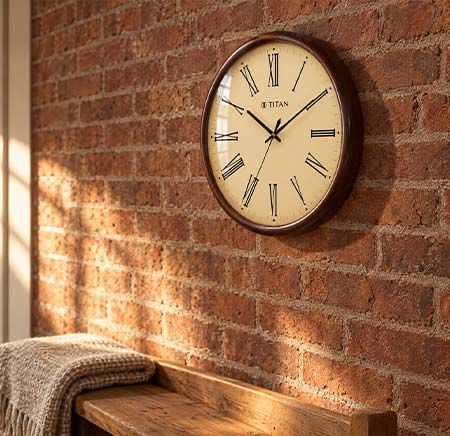
There are rooms where an ultra-minimal clock would look strangely new. There is a wooden coffee table, warmer upholstery and a few objects that were collected rather than chosen together in one afternoon. In that kind of room, the Titan Classic Wooden Wall Clock makes sense almost immediately.

Its brown wooden case surrounds a warm dial with Roman numerals. At 41.5 × 41.5 cm and 5 cm thick, it has enough presence to hold a clear wall on its own, particularly above a console or across from the main seating area.

Wooden construction - The case is wood, not simply a wood-effect finish. That warmth is what makes the clock work particularly well with timber furniture, cream upholstery and earthy interiors.

Roman numeral dial - The numerals give it a more established look without pushing the design into something overly ornate. It feels traditional, but still easy to live with.

Silent sweep - The hands move without the regular tick of a conventional quartz clock. That becomes more valuable when the clock is hanging five feet from the sofa rather than at the end of a hallway.

MRP ₹4,695*

*Click the image to check current prices


Titan Metallic Wall Clock

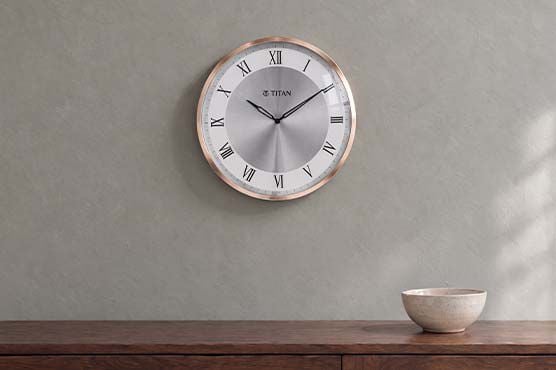
Metallic details tend to look best when you notice them twice. A little brass on a lamp. A warm metal edge around a mirror. Perhaps the handles on a sideboard. Add one more related note and suddenly those small details begin to feel intentional. That is where the Titan Metallic Wall Clock works well.

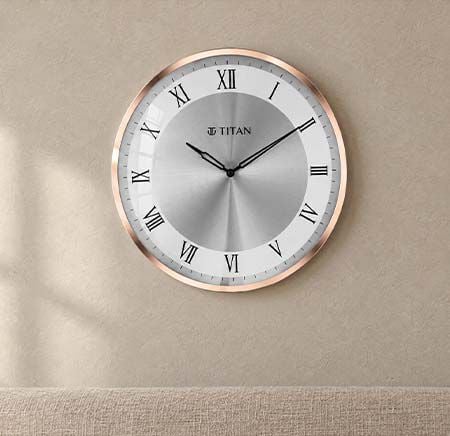
Its 40 cm metal case has a rose-gold finish around a white dial, with domed mineral glass and sunray aluminium detailing. It is polished without becoming fussy, which makes it easier to place in a contemporary room than something heavily decorative.

Rose-gold metal case - This is not a finish you need to match exactly. It is enough that the room already leans towards warmer metals rather than cool chrome or steel.

40 cm scale - Give it some space. Above a console or on a relatively clear wall, 40 cm has enough presence to feel deliberate.

Silent-sweep movement - No regular tick means you can place it relatively close to the seating area without giving yourself another background noise to notice.

MRP ₹5,095*

*Click the image to check current prices


Titan Contemporary Colours Wall Clock

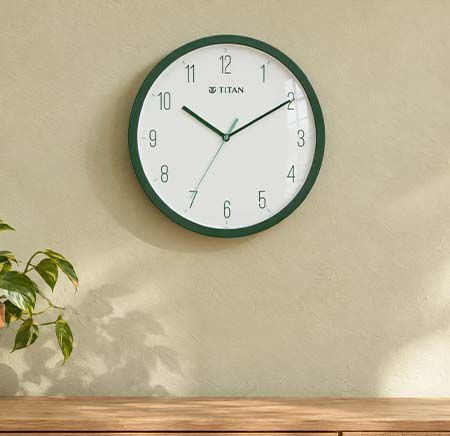
What do you do when the living room has plenty of beige, white and wood, and the wall still feels a little flat? Sometimes adding a pop of colour is enough, especially with the green Contemporary Colours Wall Clock.

Colour accent - The green works particularly well if there is another small echo somewhere in the room like a plant, cushion, artwork or ceramic. It does not need to be a perfect match.

32 cm size - This is useful when the clock has to share wall space. Artwork, photographs and shelving can sit nearby without the wall immediately feeling overloaded.

Silent sweep and clear numerals - Arabic numerals make the dial quick to read, while silent sweep keeps things calm if the clock sits near a sofa or reading corner.

MRP ₹1,995*

*Click the image to check current prices


Titan Classic Pendulum Wall Clock with Chime

There are people who look at this wall clock and immediately think of the one they grew up with. You hear the hour marked by a Westminster chime. You notice the pendulum moving as you walk past. You might even find yourself checking the time because the clock has become part of the room's rhythm.

Westminster chime - The chime is part of the personality of the clock, not an extra buried in the specifications. If you like a home that has a little sound and ritual to it, that can be lovely.

Automatic night shut-off - The chime switches off automatically between 10 PM and 6 AM, which is a thoughtful detail when the charm of an hourly chime starts competing with sleep.

Pendulum and placement - Because the clock measures 52 cm high and 31 cm wide, check what sits underneath it. A shelf or console placed too close can make the pendulum look squeezed rather than elegant.

MRP ₹5,995*

*Click the image to check current prices


Titan Premium Digital Wall Clock

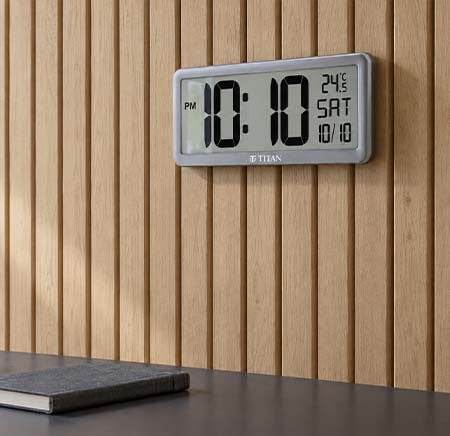
There is something satisfyingly direct about a digital clock. No hands or markers. No quick mental calculation when you are half-looking at it from the kitchen. The Titan Premium Digital Wall Clock gives you the time immediately, along with the date, day, month and temperature. Its grey rectangular display measures 32.5 cm long, 12.5 cm wide and 4 cm thick, giving it a much lower, wider profile than any of the analogue clocks here.

More than the time - The extra information makes sense in a living room that doubles as a family space, work zone or open-plan area where the clock is being checked often rather than admired occasionally.

A more modern presence - This clock wants contemporary surroundings. Against heavily carved furniture or a traditional feature wall it may feel out of place, but near a clean console or work corner, the same simplicity becomes the point.

Price: ₹3,895*

*Click the image to check current prices

How to Choose a Wall Clock for Your Living Room

The best way to choose a wall clock is to stop looking at clocks for a moment. Look at the wall instead.

  • Start with the wall, not the room

A large living room does not automatically need a large clock. What matters is how much usable wall you actually have. A 40 cm clock can work beautifully in a compact apartment if it has a clean wall to itself. The same clock can look crowded in a much larger living room if it is trying to fit between a bookshelf, artwork and the television.

  • Look at what is underneath it

The sofa matters, but so does the console. A small clock above a narrow cabinet can look perfectly proportioned. Put the same clock above a long three-seater sofa and it can suddenly look as though somebody forgot to order the larger size.

You are really arranging the furniture and the clock together. One easy trick is to cut newspaper or cardboard to roughly the dimensions of the clock you are considering and tape it temporarily to the wall. Then sit down. If it looks wrong from the sofa, no product photograph is going to rescue it.

  • Match materials without making everything match

A room where the lamp, table, clock, mirror and cabinet handles all match perfectly can start feeling less like a home and more like a showroom. Aim for a relationship rather than an exact match.

Warm wood sits naturally with beige, cream, tan and earthy fabrics. Dark metal can sharpen a pale room. Rose gold or brass tones feel at home around warmer lighting and similar hardware. And if the room is already very neutral, colour can be more useful than another safe finish. The goal is to make the clock look connected to the room without making it disappear completely.

  • Decide whether you want to hear it

Sound rarely enters the decision when you are looking at a photograph online. It becomes much more important once the clock is actually hanging near the sofa. A silent-sweep clock is generally the easiest option around seating, televisions, reading corners, and work areas. A ticking clock can have its own charm if the rhythm does not bother you. And a chime clock is something else entirely.

There is nostalgia in hearing a clock mark the hour. There is also the possibility that, after the twentieth Westminster chime, you discover nostalgia has limits. Choose accordingly.

Wall Clock Placement - Design and Vastu Context

Choosing the clock is only half the decision. You also need to place it where it is easy to see, suits the room and looks balanced on the wall. It helps to separate two different questions here:

  • Design and practical placement - Will the clock be visible, proportionate, and comfortable to read?
  • Traditional Vastu guidance - Does the chosen wall or direction align with the Vastu practices you follow?


1. Which Wall Should You Choose?

Choose a wall that is easy to see from the main seating area. In an open-plan room, also check the view from the dining table or kitchen. Watch for glare from windows and lights, especially on clocks with glass over the dial. A beautiful wall is not much use if you cannot comfortably read the time from the sofa.

According to common Vastu traditions, north and east walls are often preferred for wall clocks. Interpretations vary, so consider this alongside practical factors such as visibility and room layout.

2. How High Should You Hang a Wall Clock?

There is no single correct height. A clock above a console will sit differently from one above a sofa, while pendulum clocks need extra space below them. The simplest test is to view the clock from where you normally sit. If you have to noticeably tilt your head upwards, it is probably too high. Before drilling, mark out the clock's dimensions with paper or cardboard. It is an easy way to check both height and proportion. Traditional Vastu guidance may include preferences about placement and direction, but it does not replace these practical checks.

3. Can You Put a Clock Above a Sofa?

Yes. Treat the clock and sofa as one composition. Centre the clock in relation to the furniture arrangement rather than automatically centring it on the entire wall. Leave enough space above the sofa for the clock to breathe without making it feel disconnected.

A larger clock can often stand alone, while a smaller one may work better as part of an arrangement with artwork or other decor. In Vastu traditions, some directions may be preferred, but interpretations vary and these preferences are not guarantees of luck, wealth or health. The clock should still remain visible, proportionate and securely placed.

4. Which Colour Wall Clock Is Lucky?

Vastu traditions sometimes associate particular colours with different directions or qualities. For a north wall, metallic finishes, white and grey are commonly recommended. For an east wall, wooden tones such as brown and shades of green are frequently suggested. But these associations should be understood as cultural beliefs rather than guaranteed outcomes. For the room itself, choose colour more practically. Green can lift a neutral wall, rose gold can echo warm metallic accents, and dark wood can add depth to a pale interior. Whatever the finish, make sure the hands and numerals have enough contrast to remain easy to read.

Once you know where the clock is going and what kind of look you want, size becomes much easier to judge. The next step is simply matching the clock to the amount of wall space you actually have.


Best Wall Clocks by Room and Wall Size

The best size depends more on the available wall than the room itself.

  • Small or visually busy room - Around 27 - 32 cm works well when the clock needs to sit alongside artwork, shelves or photographs. The 32 cm Titan Contemporary Colours Wall Clock is a good fit here.
  • Medium room with a clear wall - Look around 32 - 40 cm for a balance of presence and readability. The 40 cm Titan Metallic Wall Clock works well when you want the clock to feel more noticeable without becoming a statement piece.
  • Large hall or feature wall - Go 40 cm and above, or consider a pendulum design. The Titan Classic Wooden Wall Clock measures 41.5 cm, while the Classic Pendulum Wall Clock reaches 52 cm and needs extra clearance below.
  • Open-plan room - Prioritise visibility from the sofa, dining area and kitchen. If the clock sits near a television or work zone, a silent-sweep movement is usually the easier choice.

By this point, the right wall clock should feel less like a separate purchase and more like the final piece of the room. The size should suit the wall, the finish should make sense with the furniture and lighting, and the movement should fit the way you actually use the space.

That is what makes a wall clock work well in a living room. It tells the time, of course, but the better ones also bring character and a sense of completion to the wall they sit on.

FAQ'S

It depends on the room and wall. Wooden clocks add warmth to traditional or neutral interiors, while metallic designs suit contemporary spaces. Smaller coloured clocks fit more easily around existing artwork, while pendulum clocks work well on feature walls where movement and sound can become part of the room.

Yes. A wall clock combines decoration with a practical function. It works best when the dial is visible from the seating area, its scale suits the wall and its design relates to the rest of the room.

Commonly cited Vastu traditions often prefer north and east walls. Interpretations vary, so treat this as a traditional belief rather than a universal or scientific design rule.

Vastu traditions associate different colours with particular directions or qualities, but they do not guarantee any specific outcome. Choose a colour that complements the room and provides enough contrast for easy reading.

As a starting point, 27 - 32 cm suits compact or visually busy walls, while 32 - 40 cm works well on many clear living-room walls. For a larger feature wall or hall, 40 cm or more can provide better presence. Viewing distance, the furniture beneath the clock and surrounding artwork matter more than the room’s total size.

Often, yes. Near a sofa, television, reading corner or desk, a silent sweep avoids repetitive noise. A ticking or chime clock may still be preferable if you enjoy hearing it.