Find the smart watch for men that fits your routine. Compare AMOLED displays, calling, health tracking and GPS across Titan and Fastrack picks for 2026.
Your alarm goes off before you're fully awake and your first look goes to the wrist before your feet hit the ground. You might see a missed call, last night's sleep score, or just a reminder to get up and move. Already, you're seeing more than the time.
This is a regular Tuesday. A call or message lights up the wrist on your way to work. You catch your heart rate without breaking focus during gym sessions. On a weekend joyride, you follow the route without pulling out your phone for navigation.
All this information now sits on your wrist. And the smartwatch you now choose, has to give you much more. But the best smart watch for men is not necessarily the one that does the most. It’s the one whose strengths line up with the way you actually intend to use it.
Log In To Unlock Up To 10% Off* On Your Purchase
If value is the priority, Fastrack Astor FR2 Pro is worth watching, with a 3.63 cm AMOLED display, 466 × 466 resolution, Bluetooth calling, an AI voice assistant, 100+ sports modes, IP68 protection and up to five days of stated battery life. Titan Crest suits buyers who want a round AMOLED smartwatch with calling, wellness tracking and everyday functions, including always-on display, heart-rate, SpO₂, sleep with REM and stress monitoring. Titan Zeal offers a larger 1.85-inch AMOLED display, AI Coach, 100+ sports modes and auto multisport recognition, making it a stronger fitness-focused option. At the premium end, Titan Evoke S takes a more design-led approach with a 1.7-inch AMOLED display, metal case, magnetic precision buckle, Smart Glance, AI Chat and Bluetooth calling, while Titan Celestor 2.0 is the specialist choice for outdoor training, adding dual-band GPS, offline maps, Return-to-Start, ABC sensors and detailed training metrics.
A morning run, a packed workday and a weekend outdoors can each ask something different of a smartwatch. Across the Titan and Fastrack range, you’ll find smartwatches for all kinds of days, from everyday calling and wellness tracking to fitness, AI features and outdoor navigation.
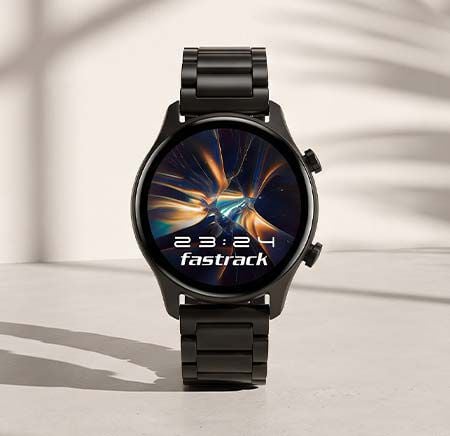
Astor FR2 Pro packs quite a lot into its price. The 3.63 cm AMOLED display has a sharp 466 × 466 resolution and sits inside a round metal case with a black stainless-steel strap. At 52 mm long, 46 mm wide and 11.5 mm thick, though, this is not a particularly discreet watch.
Price: ₹3,499*
*Click the image to check current prices
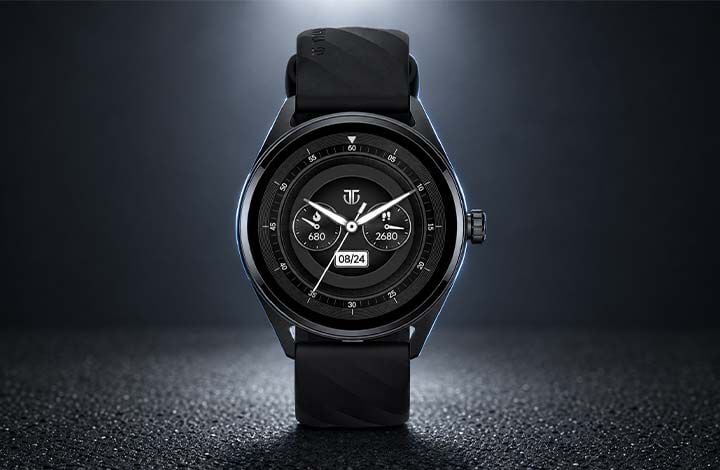
Move up from the basics, and a smartwatch starts to offer more than calls, notifications and fitness tracking. Wellness features such as sleep, heart rate, and stress tracking give you more information to work with, on top of the everyday functions you already use. Titan has two options in this range, each taking a different approach to what you can do from your wrist.
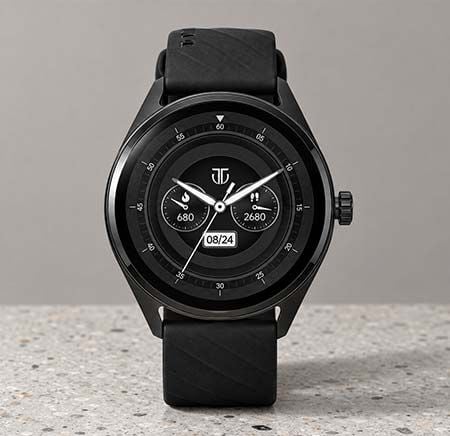
Titan Crest is built for people who want everyday functions and health tracking from the same watch. It has a round design, functional crown, aluminium case, and silicone strap. The 3.63 cm AMOLED display has a 466 × 466 resolution and supports an always-on display, with bluetooth calling working through SingleSync when the watch is connected to your phone. The aluminium case measures 47.2 mm across and 10.6 mm thick, which can feel perfectly comfortable on a larger wrist.
Price: ₹7,995*
*Click the image to check current prices
Fitness takes a bigger role with Titan Zeal. The large display gives workout information more room on the screen, with advanced features giving you additional ways to track your workouts.
Price: ₹8,995*
*Click the image to check current prices
At the premium end, the choice gets more specific. You might want a watch that looks as good at dinner as it does during the day, or one that can keep up with longer rides, runs and outdoor training. Titan Evoke S and Titan Celestor 2.0 take those two directions.
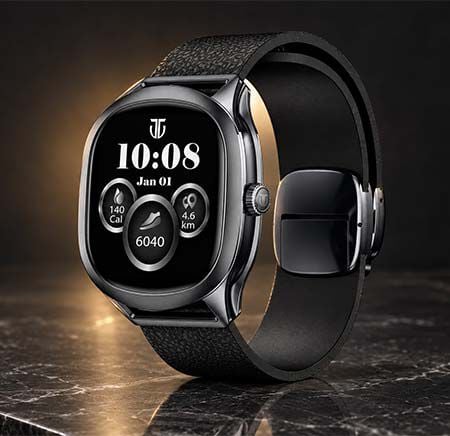
There are smartwatches you buy for your workout. Titan Evoke S feels more like one you buy because you’re going to see it on your wrist all day.
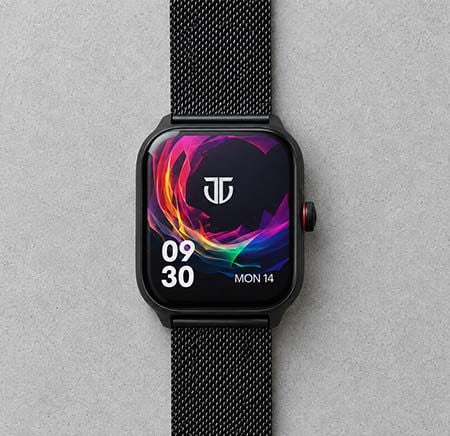
The square metal case measures 49.8 × 40.5 mm and is 10.5 mm thick. A black silicone strap keeps things from becoming too formal, while Titan’s magnetic precision buckle gives the whole design a cleaner finish than the usual pin-and-hole arrangement.
The 1.7-inch AMOLED display has a 336 × 336 resolution, reaches up to 1,000 nits of brightness and supports an always-on display.
Price: ₹8,999 *
*Click the image to check current prices
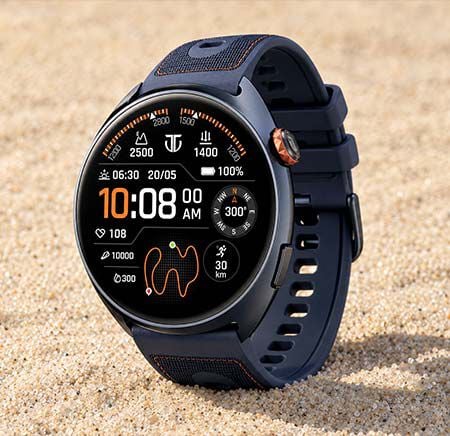
Titan Celestor 2.0 starts making sense when your workout has a route. A treadmill does not particularly care about dual-band GPS. A long run through unfamiliar streets does.
Its 1.43-inch AMOLED display has a 466 × 466 resolution and reaches up to 1,000 nits of brightness. The round case measures 46.5 mm across and 11.5 mm thick, paired here with a silicone-and-nylon hybrid strap. But the screen is almost secondary to what the watch is capable of doing once you are outside.
Celestor is also the easiest watch here to rule out. If your idea of exercise rarely leaves the gym, its headline features may be expensive extras. But if your weekends involve running routes, cycling distances or disappearing onto trails, this is where the premium starts to make sense.
Price: ₹12,499*
*Click the image to check current prices
Sometimes the decision comes down to what you want your watch to do and how you want to use it. Here is a quick look at how smart and analog watches differ in daily life.
A smartwatch is useful when you want more information and connected functions on your wrist. An analog watch keeps the experience centred on the time, the design and the watch itself. And you don't have to make the choice permanent. There's room for both in the same collection, depending on where the watch fits into your day.
If you’re wondering how to choose the best smart watch for men, it comes down to what your week actually looks like. Someone who runs or cycles often will get more out of GPS than AI watch faces. For a desk-bound day, the calling, notifications and comfort probably matter more. And if the watch is doing double duty as part of your everyday style, the case, dial and strap are worth a proper look too.
Start with the features you know you'll use, then look at the design, comfort and battery life that come with them. Price should follow from that, not the other way round. It's a better way to land on a watch that actually fits your routine than picking by price tag alone.
You'll be looking at the display for everything from the time and notifications to workout information. AMOLED screens tend to offer strong contrast and vibrant colours. Resolution is what determines how sharp the text and graphics look on top of that.
Screen size matters too. A larger display makes information easier to read, but the case needs to feel comfortable on your wrist. An always-on display is useful if you want to check the time without raising your wrist or tapping the screen.
Battery life determines how often you'll need to charge your watch. The advertised figure is usually based on specific usage conditions, so calls, notifications, workouts, GPS and other active features can bring the actual runtime down.
If you plan to wear your smartwatch through the day and night, weigh the battery life against the features you'll actually use most.
Bluetooth calling lets you make and answer calls from your wrist when the watch is connected to your phone. This comes in handy during a commute, at your desk, or whenever your phone isn't within easy reach. Check whether the watch supports calling through its companion app, and whether your phone meets the compatibility conditions it needs.
Sports modes are useful if you want to record different types of workouts. Some watches go further, with features such as auto activity recognition and training metrics.
GPS becomes more relevant if you run, cycle or spend time outdoors. Built-in GPS can track your route without relying on your phone for location data. If navigation matters to you, look for features such as offline maps, Return-to-Start and additional outdoor sensors.
Health features become useful when you stop expecting them to give you an answer and start using them to notice patterns. Perhaps your sleep consistently drops during the busiest part of the month. Maybe your resting heart rate changes as your training load increases. Or perhaps looking at several nights together confirms what you already suspected that scrolling until 1 AM is not doing your mornings any favours. Heart-rate, SpO₂, sleep and stress tracking can all add context to your routine.
They are still consumer wellness tools. Fit, movement and how you wear the watch can affect readings, and none of these measurements should be treated as a substitute for medical testing or professional advice.
A smartwatch needs to work properly with the phone and apps you already use. Check the supported Android and iOS versions, the companion app requirements and Bluetooth compatibility before you buy. It's also worth checking what permissions the app asks for, especially if you plan to use health, calling or notification features.
A watch can have every feature you want and still spend most of its time sitting on your bedside table if it's uncomfortable. Look at the case size, strap material, buckle and overall shape. You'll be wearing it for hours at a time, so comfort matters just as much as what's on the screen.
Log In To Unlock Up To 10% Off* On Your Purchase
Fastrack Astor FR2 Pro is one of the stronger choices in this shortlist. It combines a 3.63 cm AMOLED display with 466 × 466 resolution, Bluetooth calling, an AI voice assistant, 100+ sports modes and IP68 protection.
Yes. Titan offers a versatile smartwatch range designed for different lifestyles and priorities. Crest is a dependable everyday all-rounder, Zeal adds a larger display and stronger fitness features, Evoke S combines premium design with AI-led convenience, and Celestor 2.0 is an excellent choice for outdoor enthusiasts who want GPS and navigation. With options across everyday wellness, fitness, style and outdoor training, Titan makes it easy to find a smartwatch that matches the way you plan to use it.
AMOLED displays use self-illuminating pixels, which allows black areas of the screen to switch off completely. That can create deeper blacks, strong contrast and vivid-looking watch faces. AMOLED alone does not guarantee a great display, though. Resolution, brightness, size and software all contribute to how the screen looks in everyday use.
It varies considerably with both the model and the way you use it. Astor FR2 Pro and Titan Crest have battery life of up to five days, while Celestor 2.0 has up to seven days. Features such as always-on display, Bluetooth calls, GPS, notifications and frequent workout tracking can reduce the actual runtime.
Some functions do. The watch can generally continue handling basics such as time, alarms and certain workout functions without an active phone connection. Celestor 2.0 also has built-in dual-band GPS, offline maps and offline music, making it less dependent on the phone during outdoor activity. Bluetooth calling, synced notifications and several connected functions still require a compatible paired phone.
Not automatically. IP68 is a rating for resistance to dust and water ingress under specified test conditions. It should not be taken as a blanket swimming certification. If you intend to swim with a smartwatch, check the guidance for that exact model rather than relying on the IP rating alone.
Removed from the wishlist
Product moved to cart
Add minimum 2 products to compare
You may compare up to 4 items at a time
Added to wishlist