Discover the best mechanical watches for men in India with Titan. Explore automatic and manual-winding watches, movements, styles, prices and expert buying tips.
A mechanical watch asks you to participate.
There is no battery quietly doing all the work. Instead, a mainspring stores energy, gears carry it through the movement, and an escapement releases it a fraction at a time. Depending on the watch, that energy may come from the motion of your wrist or from the simple ritual of turning the crown.
That is part of what makes mechanical watches fascinating. It is also what gets you more involved in the whole selection process.
A skeleton dial may let you see the entire mechanism at work, but it still needs to tell the time clearly. A slim mechanical watch can disappear beneath a cuff, while a thicker one may deliberately make its presence felt. Power reserve, case dimensions, water resistance, strap, servicing and movement architecture all change the experience long after the first impression has passed.
So when comparing the best mechanical watches for men in India, do not stop at the fact that there is a mechanical movement inside. Look at what the rest of the watch does with it.
Log In To Unlock Up To 10% Off* On Your Purchase
The right choice depends on what part of mechanical watchmaking interests you most. Seeing the movement, wearing it every day, exploring an in-house calibre or experiencing just how slim mechanical engineering can become. Because it’s also important to note the deviations in each watch, especially if you consider that every automatic watch is mechanical, but not every mechanical watch is automatic.
Titan's mechanical range explores this in very different ways. The Octane Aerobatics brings a sportier, aviation-inspired expression, the Mechanical Slimline combines visible mechanics with a remarkably slim profile, while the Edge Mechanical pushes mechanical watchmaking into an ultra-slim 5.65mm case. For those interested in contemporary Indian movement development, the Ceramic Fusion Automatic is driven by Titan's in-house VETRA 7A20-S calibre, bringing the movement itself into the design through its skeletal construction.
At its simplest, a mechanical watch stores energy and releases it slowly enough to measure time. It keeps time through a system of springs, gears, an escapement and a regulating mechanism. There is no battery and no electronic quartz oscillator. Energy is stored, transferred and released in carefully measured steps until the hands move around the dial.
A wind-up toy works on the same broad principle. Turning its key tightens a spring, then gears release that energy gradually. A watch uses a more finely regulated mechanism to divide that energy into regular intervals over many hours.
● Mainspring - A coiled spring that stores the energy used by the movement.
● Gear train - A sequence of wheels that carries energy from the mainspring towards the hands.
● Escapement - The mechanism that releases stored energy in measured steps rather than all at once.
● Balance wheel - An oscillating regulator that works with the hairspring to govern timekeeping.
● Winding system - The mechanism that supplies energy to the movement. In a manual-winding watch, turning the crown winds the mainspring by hand. In an automatic watch, a rotor moves with your wrist and winds the mainspring as you wear it.
● Power reserve - The length of time a fully wound watch can continue running before it needs to be wound again. Depending on the movement, this may be around 40 hours or extend to 72 hours or more.
Automatic and manual-winding watches use mechanical movements powered by a mainspring. What changes is how that spring is wound, which affects how you interact with the watch during everyday wear.
● Automatic watches use a rotor that moves with your wrist to wind the mainspring. When worn regularly, they generally need less manual winding.
● Manual-winding watches require you to turn the crown by hand to wind the mainspring. For some enthusiasts, winding the watch becomes part of the ownership experience.
● Power reserve depends on the movement, not just the winding method. Both types continue running for a set period after being fully wound, then need more energy.
An automatic watch can still stop if left unworn beyond its power reserve, and a manual-winding watch needs regular winding by hand. Neither system is inherently better. Ultimately, both are mechanical watches.
At this level, the attraction is often the opportunity to enter mechanical watchmaking without moving immediately into specialist-watch pricing. Case size, crystal, strap, warranty, legibility and service support can matter more to everyday enjoyment than decorative ambition. A watch that looks exciting online but feels cumbersome on the wrist is unlikely to become the one you reach for regularly.
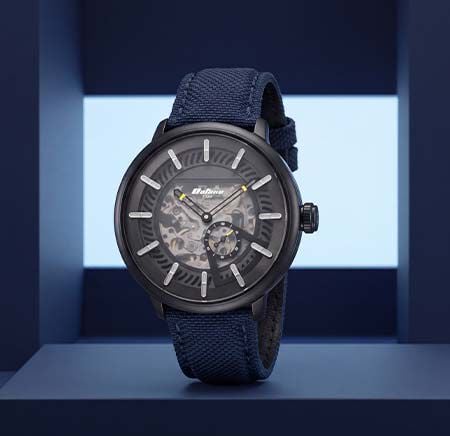
The Titan Octane Aerobatics Mechanical Analog Black Dial Nylon Strap Watch for Men interprets aviation through engineering details rather than decorative motifs. The anthracite-toned semi-skeleton dial exposes the moving gears, while the rotating seconds display at 5 o’clock resembles a cockpit instrument. Yellow-tipped luminous hands preserve legibility in low light. At 14.8 mm thick, it makes sense for weekends and travel better than understated formal settings.
● 42.1 mm case width with a 45.9 mm length and transparent caseback
● Stainless steel case and mineral glass
● Blue nylon strap with yellow lining and buckle clasp
● 150 g weight and 50 metre water resistance
● 24-month movement warranty
MRP ₹22,395*
As the price rises, “mechanical” should gradually stop being the entire argument. That may be a better-developed movement, stronger casework, finer finishing, more considered materials, a useful complication or greater attention to the dial and bracelet. The value should be visible in the watch itself, not only in its specification sheet.
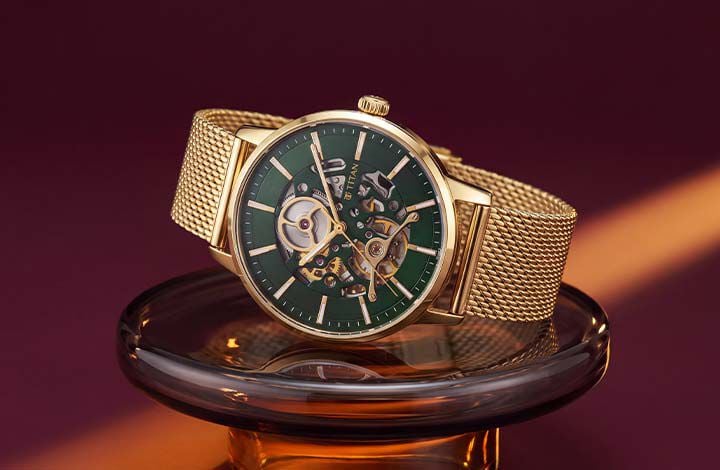
The Titan Mechanical Slimline Green Dial Golden Mesh Strap Watch for Men makes mechanics feel ceremonial. Its openworked centre and concentric cut-outs appear to float within a deep green chapter ring. At its centre is what Titan describes as a high-precision mechanical movement, operating without a battery. The polished bezel and profiled hands catch light without distracting from the movement. The continuous gold tone works well for festive evenings and milestone occasions, and the 9.16 mm profile gives the dial presence without adding bulk.
● High-precision mechanical movement with an approximately 40-hour power reserve
● Milanese mesh bracelet with breathable, close-draping fit
● 42 mm case width with a 49 mm length
● Mineral glass, push-button clasp and transparent caseback
● 50 metre water resistance
MRP ₹27,995*
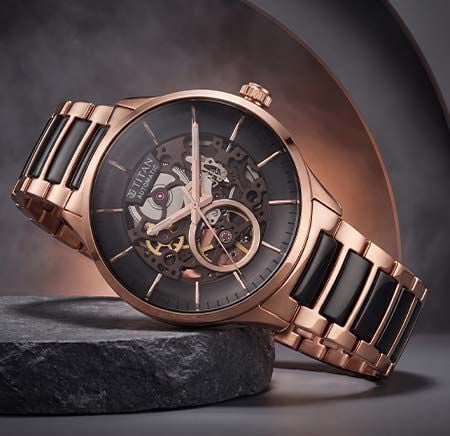
The Titan Ceramic Fusion Automatic Black Dial Stainless Steel With Ceramic Links Strap Watch for Men turns the mechanism into the design. Its skeleton aperture reveals the balance wheel, mainspring barrel and gear train, framed by a concave black dial and warm rose-gold accents. At its centre is Titan’s in-house VETRA automatic calibre. The 7A20-S uses 22 jewels, offers a 36-hour power reserve and is rated to an accuracy of -10 to +30 seconds per day. The Titan Ceramic Fusion has enough presence for client dinners and evening gatherings, and makes a considered choice for someone who values the mechanics as much as the finish.
● 42.2 mm width, 48 mm length and 13.4 mm thickness
● In-house VETRA 7A20-S movement with 22 jewels
● 36-hour power reserve and -10/+30 seconds daily accuracy
● Domed mineral crystal, angle-cut hands and plated bezel ring
● Dual-tone steel bracelet with ceramic centre links and butterfly clasp
MRP ₹31,995*
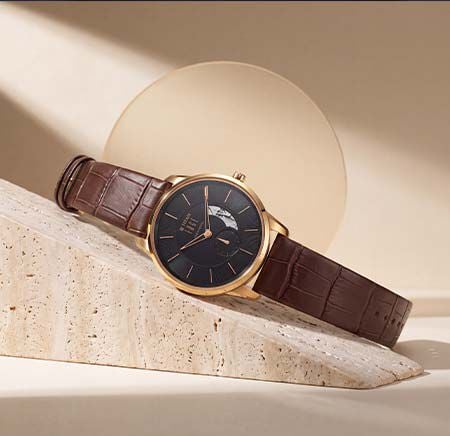
With the Edge Mechanical, the movement is the reason the watch exists. Inside is Titan’s Edge Calibre 903, an in-house hand-wound mechanical movement just 2.2mm thick. Developing something that slim meant fitting 106 precision components into an extraordinarily shallow architecture. Of those, Titan has stated that 81 are manufactured at its Hosur facility, with other components produced with Swiss partners before final movement assembly and qualification in Switzerland. Titan Company
Despite its dimensions, this is not a mechanically stripped-back movement.
It uses 18 jewels, beats at 28,800 vibrations per hour, or 4 Hz, and delivers approximately 42 hours of power reserve after winding. Titan also applies traditional decorative finishing, including Côtes de Genève and colimaçon patterns across movement surfaces.
● In-house Edge Calibre 903, manual-winding mechanical movement.
● 106 movement components, with 18 jewels and a 42-hour power reserve
● 42.7 mm case width with a 49.6 mm length
● Stainless steel case, sapphire crystal and brown leather strap
● Buckle clasp and transparent caseback
MRP ₹2,12,500*
A mechanical watch is only as interesting as the movement that drives it. VETRA is Titan’s in-house mechanical movement platform, developed and manufactured in India. At its core is the 7A architecture, which brings together more than 130 components and supports different calibres for different functions and watch designs.
Titan’s Hosur facility handles movement design and engineering, prototyping, precision component manufacturing, assembly, testing and finishing. Watches like the Ceramic Fusion are powered by the 7A20-S automatic calibre, while its skeleton dial reveals the balance wheel, mainspring barrel and gear train. This integration allows the mechanics of the watch to become part of its design.
That is also why the phrase in-house matters here without needing to be treated as a guarantee of superiority. Developing a movement internally gives Titan greater control over its dimensions, power reserve, complications and the way it integrates with the case and dial, but the finished watch still has to prove itself through accuracy, reliability, finishing and long-term serviceability. VETRA is better understood as evidence of how far Titan’s mechanical watchmaking capability has developed, from making mechanical watches to building a flexible movement ecosystem of its own.
The Octane Aerobatics is built for the rhythm of everyday wear, with a 50-metre water resistance rating, luminous hands and an aviation-inspired dial that brings character to a daily rotation. At the other end of the spectrum, the Edge Mechanical Watch keeps formal dressing pared back. Its 5.65 mm profile, sapphire crystal and black dial make it a natural companion to office wear and evening suits.
Festive dressing and wedding celebrations leave room for more expressive design, which is where the Slimline’s green skeleton dial and gold-tone mesh bracelet come into their own. For those drawn to the mechanics behind the dial, the Ceramic Fusion Automatic puts its in-house VETRA 7A20-S calibre on display. With 22 jewels and a 36-hour power reserve, it gives enthusiasts tangible details to explore beyond the watch’s appearance.
Mechanical and quartz watches use different systems to keep time. A mechanical movement stores energy in a mainspring and regulates its release through gears and an escapement. A quartz watch uses a battery and an electronic oscillator to regulate timekeeping.
Quartz watches can sit unworn for long periods without stopping, though their batteries eventually need replacing. Mechanical watches have a limited power reserve and require periodic servicing to keep the movement in good condition. Their rate can vary with position, temperature, adjustment and wear.
The choice comes down to what you value in a watch. Quartz are for buyers who prioritise precision and convenience. Mechanical watches put the movement's engineering at the centre of the ownership experience, with springs, gears and a regulating mechanism that are fascinating to follow.
Mechanical is the umbrella term for watches powered by a mainspring rather than a battery. Automatic and manual-winding watches are both mechanical, and the difference lies in how the mainspring receives energy.
● Mechanical watches use a mainspring and a system of gears to keep time. The term covers both automatic and manual-winding movements, such as the Titan Octane Aerobatics and Titan Edge Mechanical watches.
● Automatic watches wind the mainspring through a rotor that moves with the wearer’s wrist. The Titan Ceramic Fusion Automatic uses Titan’s in-house VETRA 7A20-S calibre.
● Manual-winding watches require the wearer to turn the crown by hand to wind the mainspring. They do not rely on wrist movement to wind the watch.
In short, mechanical describes how the watch keeps time, while automatic and manual-winding describe how its movement is wound. These are two types of mechanical watches, not three separate movement categories.
Begin with the winding method. Choose automatic if you want wrist movement to do most of the work. Choose manual-winding if the ritual appeals to you. Then check the power reserve, since it determines how long the watch can remain off the wrist before stopping.
Study the calibre, movement source and manufacturer’s stated accuracy tolerance. Check dial legibility, match the water resistance to its intended use and assess the strap or bracelet for comfort and occasion. Complications should reflect actual interest. A GMT is worthwhile if another time zone matters. An exhibition caseback is worthwhile if you will genuinely enjoy looking at the movement.
Next, assess the case on your wrist. Width is only one dimension. Length determines how far the watch extends across the wrist, while thickness affects balance and cuff clearance. A thin watch can still wear large if its case is long. A broad watch can remain comfortable when the lugs curve well and the bracelet articulates cleanly.
Finally, ask how the watch will be serviced, what the warranty covers and whether its price is justified by the movement, construction and design together. The best mechanical watch for men is not the one with the longest list of features. It is the one in which every feature has a reason to be there.
A good mechanical watch balances movement quality with sound construction, useful proportions, clear legibility and a design you will continue to wear.
● Movement - Look at architecture, reliability, power reserve, stated accuracy and finishing.
● Construction - Examine the case, crown, crystal, bracelet or strap and water resistance.
● Proportions - The watch should work with the wrist rather than merely impress in photography.
● Legibility - Open-worked dials are compelling only when the time remains easy to read.
● Serviceability - Mechanical ownership requires long-term care and accessible support.
● Design - The watch should succeed as a complete object rather than as a showcase for its movement.
Specifications narrow the field. A fitting reveals the truth. A watch that catches on cuffs, overwhelms the wrist or becomes difficult to read will spend more time in a drawer, regardless of the ingenuity beneath its dial.
A mechanical watch does not come with a fixed lifespan. It can remain in use for many years, but is not maintenance-free. Lubricants age, components wear and seals deteriorate. Water resistance can also change over time.
Follow the service interval recommended for the movement. If the watch begins gaining or losing time noticeably, winds differently or shows signs of moisture or impact, have it inspected. Longevity comes from repairable engineering supported by responsible ownership, not from unsupported promises of permanence.
Regular care protects both the movement and the exterior without turning ownership into a chore.
● Wind the watch according to the manufacturer's instructions.
● Avoid unnecessary shocks.
● Follow the watch's water-resistance guidelines.
● Keep the watch away from strong magnetic fields where relevant.
● Do not operate the crown underwater unless the watch is specifically designed for it.
● Store the watch appropriately when not wearing it.
● Have the movement serviced according to the manufacturer's recommendations.
● Clean the case and bracelet or strap appropriately.
Follow the guidance for your specific watch and arrange inspection when its performance or condition changes.
Log In To Unlock Up To 10% Off* On Your Purchase
A mechanical watch keeps time using a mainspring, gear train, escapement and balance wheel rather than a battery.
Mechanical is the broad category. An automatic watch is mechanical, with a rotor that winds the mainspring as the wrist moves.
Yes. Every automatic watch is mechanical, but not every mechanical watch is automatic.
It is a mechanical watch whose mainspring is wound by turning the crown by hand.
The mainspring stores energy and the gear train transfers it. The escapement releases that energy in measured steps, while the balance wheel regulates the timing.
Neither is better in every respect. Quartz is generally more precise and convenient. Mechanical watches suit owners who value engineering, interaction and traditional watchmaking.
With suitable care and servicing, a mechanical watch can remain in use for many years. Its longevity depends on wear, maintenance and the availability of appropriate service support.
Follow the manufacturer’s recommendation for the specific movement. Requirements vary by calibre, age and use.
No. They run on energy stored in a wound mainspring.
That depends on the movement’s power reserve. Some watches run for little more than a day, while longer-reserve calibres can continue for several days.
It is a movement developed by the watch brand through its own movement-development capability. The term does not by itself guarantee superior accuracy, reliability or finishing.
They are Titan watches powered by VETRA, Titan’s in-house mechanical movement platform, used in selected collections and designs.
Yes, provided the case, strap, water resistance and movement suit the wearer’s routine and the watch receives appropriate care.
Consider the winding method, calibre, power reserve, stated accuracy, case dimensions, materials, water resistance, legibility, warranty and service support. Try the watch on before deciding.
Removed from the wishlist
Product moved to cart
Add minimum 2 products to compare
You may compare up to 4 items at a time
Added to wishlist